Table of Contents
How does the painting cost calculator work?
This calculator uses your room measurements, door and window counts, and paint cost per square foot to estimate the total paintable wall area and the total material cost for the job. It automatically subtracts door and window areas from the gross wall area so your paint quantity is based on the actual surface you’ll be covering—not the full room perimeter.
Here’s what you’ll need to enter:
- Room length, width, and height (in feet): used to calculate total wall area
- Number of doors: each door subtracts a standard area from the paintable surface
- Number of windows: each window subtracts a standard area from the paintable surface
- Paint cost per square foot ($): your material cost for the chosen paint
The calculator will output your total wall area, total door area subtracted, total window area subtracted, the final paintable area, and the total material cost estimate. From there, you add labor, primer, supplies, and your markup to build a complete quote.
What affects the final painting cost estimate?
Paint job costs are driven by more variables than square footage alone. Here’s what moves the number most on a typical painting job:
- Paint quality and finish. Premium paints cost significantly more per gallon than standard options. Finish type (flat, eggshell, satin, or semi-gloss) also affects both cost and coverage rate. Higher-quality paints often cover better per coat, which can affect how many gallons you actually need.
- Number of coats. A single coat on a lightly painted wall is a very different job from two coats on a dark color change or a new-construction prime-and-paint. The number of coats directly multiplies your paint quantity and labor time.
- Surface condition and prep work. Surfaces that need repair, patching, priming, or cleaning before paint goes on add time and materials to the job. Prep work is one of the most common sources of underestimated costs on painting jobs.
- Interior versus exterior work. Exterior painting typically involves more prep, more durable (and more expensive) paint products, and weather-dependent scheduling—all of which affect the total cost.
- Ceiling and trim work. The calculator focuses on wall area. Ceilings, trim, doors, and baseboards all require their own time and materials and should be estimated separately or added as line items in your full quote.
When should you use this painting cost calculator?
This painting cost calculator works best when you have room measurements and a paint product in mind. Use it in the following situations:
- After a client walkthrough, when you’ve measured the space and know the paint type
- When a client asks for a ballpark before a formal estimate
- When comparing the cost impact of different paint products on the same job
- When quoting multiple rooms and adding up material costs before building a full estimate
- When you want to check your material quantities against what you’ve already ordered
It’s particularly useful for residential painting contractors who quote frequently and need a fast, reliable way to get to an accurate material cost before sending a formal estimate.
What the painting cost calculator does not include
This calculator estimates material costs based on wall area, but a complete painting estimate requires several additional line items:
- Primer and any specialty base coats
- Painting supplies, including brushes, rollers, tape, drop cloths, and trays
- Ceiling paint and labor
- Trim, baseboard, and door painting
- Exterior surface prep, including power washing, scraping, and/or sanding
- Surface repairs, including patching holes, filling cracks, and skim coating
- Labor costs (the calculator produces a material estimate, not a labor estimate)
- Overhead costs and profit margin
These are real costs that belong in every painting estimate. The calculator gives you a fast material baseline, but your full quote captures the complete picture.
How to turn the result into a real quote
Once you have your material cost from the calculator, here’s how to build a complete, professional painting estimate:
- Start with your calculator total. This gives you your core material cost for the paintable wall area.
- Add primer and supplies. Factor in primer, painting supplies, and any specialty materials for the job.
- Add ceiling and trim. Estimate those surfaces separately and add them as line items.
- Add prep work. Surface repairs, power washing, drywall and taping, and other prep should be priced and listed clearly.
- Add your labor. Calculate your hours based on square footage and your production rate, then multiply by your hourly rate.
- Apply your markup—add overhead and your target profit margin.
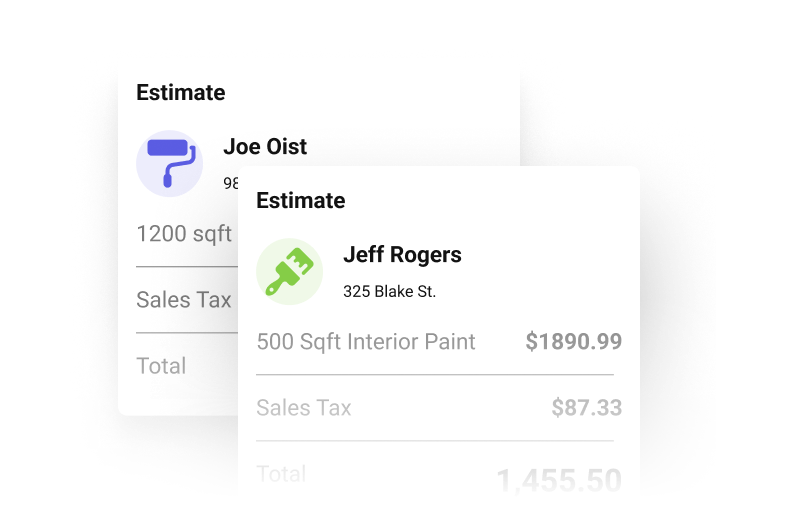
- Build and send. Use Joist to create a clean, branded estimate with all line items that your client can review, approve, and sign before you start.