The electrical work is finished. The panel is labeled. The tools are back in the van. The customer is happy. Now comes the part that keeps your business running: getting paid.
A clear electrical contractor invoice tells the customer what you did, what they owe, and how to pay. It also saves you from digging through notes at the end of a long day or answering questions about a vague charge weeks later.
This guide covers how to invoice electrical work without making the process harder than it needs to be.
How Should an Electrician Invoice for a Job?
Do not wait until the end of the job and try to rebuild everything from memory.
Use the approved estimate as your starting point, then adjust it to reflect the work completed and the final amount owed.
A simple process looks like this:
- Review the estimate: Check the original scope, price, and payment terms.
- Confirm the work completed: Remove anything you did not do and add anything the customer approved.
- Record changes: Show extra work, materials, and credits clearly.
- Deduct earlier payments: Include the deposit and any progress payments.
- Check and send the invoice: Confirm the total and send it to the right person.
That final check matters. A missing deposit or unexplained charge can turn a straightforward payment into several emails and a delayed invoice.
The bill should also reflect the job the customer agreed to. If you find damaged wiring, need extra materials, or are asked to add another circuit, confirm the change and price before carrying out the work.
Accurate invoicing starts with getting the price right in the first place.
Our guide to pricing residential electrical work shows you how to factor in labor, materials, overhead, and profit so you can quote with confidence and avoid awkward questions when the final bill arrives.
What Should an Electrical Contractor Invoice Include?
A good invoice should make sense at a glance.
The customer should be able to see who completed the work, where it took place, what they are being charged for, and how much remains to be paid.
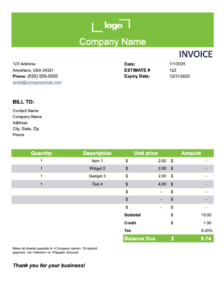
The example below shows a basic invoice layout. Electrical contractors may also need to add job-site, license, permit, and inspection details depending on the work and local requirements.
Want to create your next invoice faster?
Start with a professional electrician invoice template, then customize it with your labor, materials, payment terms, and job details.
A professional invoice should include the following information:
Your business details:
Include:
- Business name and logo
- Address, phone number, and email
- Electrical contractor license or registration number, where required.
Customer and job details:
Add:
- Customer or company name
- Billing address
- Job-site address if different
- Invoice number
- Invoice and service dates
- Purchase order or work order number, where applicable.
Work completed:
Describe the work clearly enough that the customer understands what they are paying for.
| Vague Descriptions | Better Descriptions |
|---|---|
| Electrical repair: $450 | Diagnosed recurring breaker trip and replaced damaged 20-amp circuit breaker: $450 |
The second version provides the customer with a useful record and reduces the likelihood of questions later. Keeping complete invoice and payment records can also make it easier to track income, expenses, and information needed for tax returns.
Charges and payments:
Show:
- Itemized charges
- Taxes, discounts, and credits
- Deposits and previous payments
- Remaining balance.
Payment details:
Finish with:
- Payment due date
- Accepted payment methods
- Late-payment terms, where agreed, and legally permitted
- Contact details for billing questions.
For larger jobs, you may also need to include permit numbers, inspection details, or project references. These requirements can differ depending on where you work. Many jurisdictions base their electrical requirements on the National Electrical Code (NEC), often with local amendments.
Not sure what applies to you? Our guide to electrical contractor licensing breaks down the main requirements and what to check before you start taking on jobs.
How Should Electricians Bill Labor and Materials?
How you show labor and materials should match the way you priced the job.
For time-and-materials work, list the hours, rate, and materials used. For a fixed-price job, it may be clearer to bill by completed task or project stage instead.
Here is a simple time-and-materials example:
| Line Item | Quantity | Rate | Total |
|---|---|---|---|
| Diagnostic service call | 1 | $125 | $125 |
| Panel installation labor | 5 hours | $110 | $550 |
| Breakers and electrical materials | 1 | $325 | $325 |
| Total | $1,000 |
A typical electrical invoice may include:
- A diagnostic or service-call fee
- Hourly or flat-rate labor
- Breakers, cable, conduit, fixtures, and other materials
- Permit or inspection fees
- Equipment rental or subcontractor costs
- Emergency or after-hours charges
- Taxes, discounts, and credits.
You do not need to list every screw or connector separately.
Grouping low-cost consumables under a line like “electrical supplies” can keep the invoice readable. Higher-value items, such as a panel, EV charger, or specialist fixture, should usually be shown clearly.
Should Electricians Show Material Markup?
Usually, the customer only needs to see the selling price you agreed on. You do not have to show what you paid your supplier or how much profit is built into each item.
The exception is cost-plus work. In that case, show the material cost and markup as set out in the contract.
Whatever approach you use, keep it consistent from estimate to invoice. The prices and descriptions should match so customers can easily understand the final bill.
Related Reading: 2026 Contractor Pricing Guide: How to Price for Profit
Which Electrical Billing Method Should You Use?
There is no single billing method that works for every electrical job. Replacing a standard outlet is easy to scope. Finding an intermittent fault in an older home is not.
| Billing Method | Best For | Example |
|---|---|---|
| Flat rate | Predictable, clearly defined work | EV charger installation |
| Time and materials | Repairs or uncertain scope | Tracing an intermittent wiring fault |
| Progress billing | Larger projects completed in stages | Whole-home rewiring |
| Recurring billing | Ongoing service agreements | Quarterly commercial maintenance |
Flat-rate billing:
You charge a single, agreed-upon price for a defined job. This works well for repeatable tasks such as installing a ceiling fan, replacing an outlet, or fitting an EV charger.
Spell out what the price covers. If the customer asks for more work, treat it as a change rather than quietly adding it to the final total.
Time-and-materials billing:
You charge for the hours worked and materials used. This suits troubleshooting, repair work, and older properties where you cannot see the full scope at the start.
Track time and materials as you go. Trying to remember every connector, breaker, and half hour later is where money slips through the cracks.
Progress billing:
You divide a larger project into agreed-upon stages. A rewiring job might include a deposit followed by payments after rough-in, trim-out, inspection, and completion.
Each invoice should show the full contract value, payments received, the current charge, and the balance left.
Recurring billing:
Recurring invoices work well for maintenance agreements, property managers, and commercial customers. Set a monthly, quarterly, or annual schedule based on the contract.
How Should Electricians Handle Deposits and Changes?
Some electrical jobs cost money before the work even starts.
You may need to order an expensive panel, pay permit fees, reserve extra labor, or buy specialist equipment that cannot be returned. A deposit helps cover those upfront costs and protects your cash flow.
You might request one for:
- High-value panels, fixtures, or equipment
- Custom or nonrefundable materials
- Permit or inspection fees
- Labor booked for a longer project
- Other agreed-upon upfront costs.
Set out the deposit amount, due date, and payment schedule in the estimate or contract. Then show every payment clearly on future invoices so the customer can see exactly how you calculated the remaining balance.
For example:
| Project Summary | Amount |
|---|---|
| Original project total | $6,500 |
| Approved change | $650 |
| Deposit received | -$2,000 |
| Progress payment received | -$2,500 |
| Remaining balance | $2,650. |
Changes need the same level of care.
Suppose a customer asks you to add a dedicated EV charger circuit halfway through a panel upgrade. Confirm the extra work and price before going ahead, then record it clearly on the invoice:
Added a dedicated 40-amp circuit for EV charger following customer approval: $650.
That is much easier for the customer to understand than an unexplained $650 charge at the end of the job. It also gives you a clear record if questions come up later.
Deposit limits and change-order requirements can vary by location, so check with your state contractor licensing agency before setting your standard terms.
Related Reading: Estimate vs. Proposal vs. Quote: What Contractors Should Send and When
Residential vs. Commercial Electrical Invoicing
Residential and commercial invoices include many of the same details. The main difference is how the invoice is approved and paid.
| Area | Residential Jobs | Commercial Jobs |
|---|---|---|
| Who gets the invoice | Homeowner or landlord | Accounts payable, contractor, or facilities team |
| When payment is due | Often when the job is finished | Based on the agreed payment terms |
| Key details | Customer and job-site address | PO, project, site, or work-order number |
| Extra documents | Clear job description and receipts if needed | Work orders, timesheets, and change orders |
| Common billing method | Flat rate or time and materials | Progress, contract, or time and materials |
For residential jobs, keep the invoice simple. Explain the work in plain language, clearly show the total, and make it easy for the customer to pay.
Commercial invoices may need more information and can take longer to process. Before starting the job, check who should receive the invoice, which reference numbers to include, and whether any extra documents are needed.
The person who approved the work may not handle the payment. Sending the invoice to the wrong contact can delay payment, even if everything else is correct.

How Electrician Billing Software Cuts Down the Paperwork
Leaving invoices until later makes it easy to forget job details, miss a material, or overlook a deposit.
Electrician billing software keeps the estimates, job notes, payments, and final invoices in one place. Look for tools that let you:
- Create estimates and invoices from your phone or computer
- Turn an approved estimate into an invoice
- Save common services, labor rates, and materials
- Record deposits and progress payments
- Add photos, attachments, and job notes
- Accept online payments
- Track unpaid invoices and send reminders.
Joist’s electrical estimating and invoicing app connects the full process:
Estimate → approval → deposit → invoice → payment
You do not need to re-enter the same job details at every stage. That means faster invoicing, fewer missed charges, clearer records, and less admin waiting for you at the end of the day.
You spend less time chasing paperwork and more time on billable work.
FAQs: Electrical Contractor Invoicing
Should every electrical invoice have a unique number?
Can electricians send invoices by email or text?
Yes. Digital invoices are often faster to deliver and easier for customers to pay. Make sure the file or link opens properly, includes all the agreed details, and goes to the correct billing contact.
Should electricians attach photos or receipts to an invoice?
What should an electrician do when an invoice is overdue?
How long should electrical contractors keep invoices?
Article Sources
- Internal Revenue Service (IRS), What Kind of Records Should I Keep?, July 20, 2026.
- National Fire Protection Association (NFPA), NFPA 70: National Electrical Code (NEC), 2026 Edition.
- National Association of State Contractors Licensing Agencies (NASCLA), State Business and Law Exams.