If you’re still setting up, start with our guide on how to start a power washing business, then come back here to set your rates. When you’re ready to send quotes, Joist’s estimates let you build one on-site in minutes.
Quick Answer: How Much Should I Charge for Pressure Washing?
How much to charge for pressure washing depends on the surface, the size, and your costs, but most pros charge $0.30 to $0.55 per square foot for driveways and $0.10 to $0.50 per square foot for house exteriors. If you charge by the hour, the typical range is $60 to $125 per hour. A standard driveway job usually lands between $100 and $350, and a whole-house wash averages about $312. These pressure washing rates reflect 2026 market data. Use them as a starting point, then check them against your own costs and your local market. Your costs include overhead, which many new pressure-washing businesses forget to factor in.
To work out your price in one line: price = total job cost × (1 + your markup %). Compare that figure with the market rates in this guide. If your cost-based price is below the local market, you may have room to charge more. If it is above the market, you either need to justify the higher price with added value or adjust your costs, process, or target jobs.
Key Takeaways
- Market rates are about $0.30 to $0.55 per sq ft for driveways and $0.10 to $0.50 per sq ft for house exteriors.
- Hourly pricing typically runs $60 to $125 per hour. Set a minimum charge so small jobs still cover the cost of the trip.
- Hot-water (power-washing) jobs cost more than cold-water (pressure-washing) jobs, so price them separately.
- Work out your real cost per job first, including overhead. Then add a profit margin and compare the result with market rates.
- Surface type, number of stories, dirt level, and access all change the price. Build each one into your estimate.
- Track what each job really costs using expense tracking, so you can adjust your rates based on real numbers.
- Commercial jobs are usually quoted on a per-project or per-contract basis, and the rate per square foot drops as the area grows.
Pressure Washing Prices at a Glance
These figures come from homeowner cost guides, so they show what customers may expect to see, not what every pressure washing business should charge. Your own rates should reflect your region, equipment, insurance, labor, overhead, and minimum job size. Your own rates will vary by region, equipment, and your overheads.
| Job type | Typical price range | Notes |
|---|---|---|
| Driveway | $100 to $350 | Typically $0.30 to $0.55 per sq ft |
| House exterior (whole house) | $100 to $720, average $312 | $0.10 to $0.50 per sq ft, depending on siding |
| Patio | $100 to $200 | Varies with size and surface |
| Fence | $150 to $300 | Wood often takes longer to clean |
| Gutters | $50 to $150 | About $0.50 to $1.50 per linear ft |
| Roof | $450 to $700 | About $0.50 to $1.00 per sq ft |
Sources: Angi, May 2026 (driveways) and August 2026 (all other job types). See Article Sources.
Save these rates as line items in Joist, and you can quote any job in a few taps. Joist is estimating and invoicing software for contractors, and it works for trades that often work alongside pressure washing, such as landscaping and handyman work. If you also clean windows, see our guide on how to price window cleaning jobs.
How Much to Charge to Pressure Wash a House
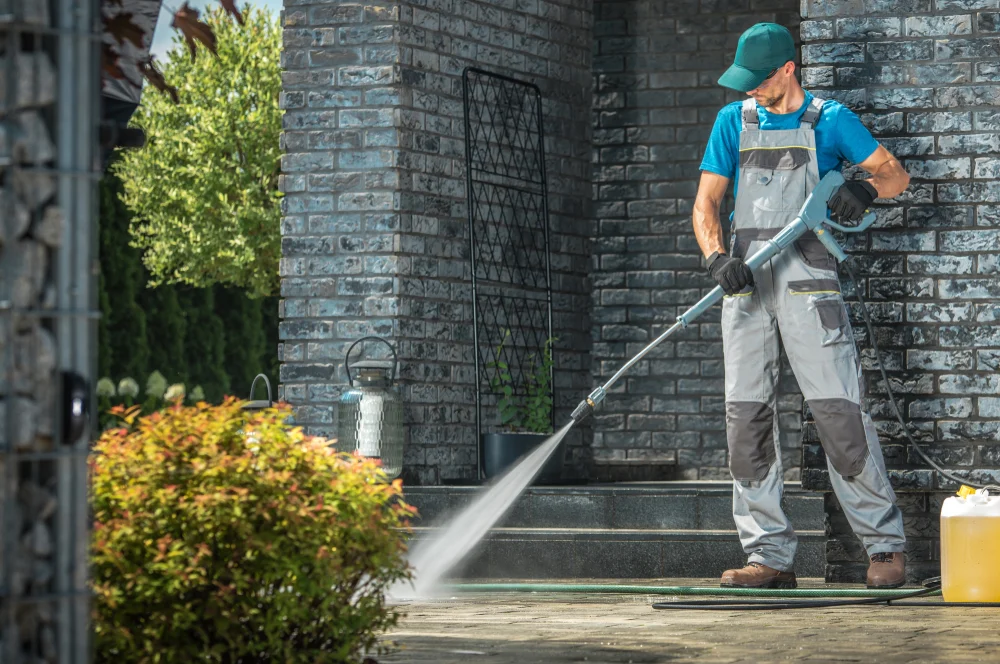
Most pros charge between $200 and $1,000 to pressure wash a 2,000 sq ft house, with a national average of about $312 across all sizes. Larger, taller houses take more time and require more equipment, so the price goes up. For siding, make sure the quoted method matches the surface. Some houses should be soft-washed rather than pressure-washed, especially if the siding, paint, roofline, or trim could be damaged by high pressure.
| House size | Typical price range |
|---|---|
| 1,500 sq ft | $150 to $750 |
| 2,000 sq ft | $200 to $1,000 |
| 2,500 sq ft | $250 to $1,250 |
| Height | Typical price range |
|---|---|
| One story | $150 to $1,000 |
| Two stories | $400 to $1,400 |
| Three stories | $700 to $1,800 |
Source: Angi, August 2026.
Pressure Washing Cost Per Square Foot by Siding Material
Pressure washing cost per square foot ranges from $0.10 to $0.55, depending on the surface. Siding changes the price because some materials need a gentler approach and more time. Typical pressure washing rates per square foot are $0.10 to $0.40 for brick, $0.20 to $0.50 for vinyl, $0.30 to $0.50 for stucco, and $0.30 to $0.55 for wood.
If you wash siding before a repaint, our guide on how to estimate a paint job shows how to price the prep work and the finish together.
How Much to Charge to Pressure Wash a Driveway
Most driveways cost $100 to $350 to pressure wash, which works out to about $0.30 to $0.55 per square foot. Driveway prices scale with surface area. A 200 sq ft driveway typically costs $60 to $110, while a 1,200 sq ft driveway runs about $360 to $660. Material matters too. For a 600 sq ft driveway, expect about $120 to $190 for concrete, $125 to $195 for asphalt, $130 to $200 for brick, and $135 to $210 for pavers or gravel.
Source: Angi, May 2026.
Pressure Washing vs. Power Washing: Price Them Separately
Power washing costs more than pressure washing because it uses heated water. Customers use the two terms interchangeably, but the work is different. Pressure washing uses cold water. Power washing uses heated water, which cuts through grease, oil, and stubborn buildup faster. Hot water equipment costs more to buy and run, and customers pay more for it. Angi lists power washing as a higher-priced service than pressure washing.
HomeGuide’s 2024 cost guide shows how wide the gap can be, with pressure washing at about $0.08 to $0.20 per sq ft and power washing at $0.35 to $0.77 per sq ft. Rates in your area will differ, so treat that as a sense of scale. If you offer both, list them as separate line items on your estimate so customers can see what they are paying for.
What About Soft Washing?
Soft washing uses lower pressure and cleaning solutions to remove dirt, algae, mold, and mildew from surfaces that can be damaged by high-pressure. It is commonly used for roofs, vinyl siding, painted surfaces, stucco, and older materials where blasting the surface could cause damage.
Price soft washing separately from standard pressure washing. The job may require less pressure but may require more chemical knowledge, dwell time, rinsing, plant protection, and care around windows, trim, and landscaping. If the surface needs soft-washing rather than pressure-washing, make that clear in the estimate so the customer understands why the price differs.
Residential vs. Commercial Pressure Washing Pricing
Commercial pressure washing is usually quoted per project or on a recurring contract, while residential work is quoted per square foot or as a flat fee. Both follow the same basic pricing logic, but they differ in ways that affect your quote. If you take on recurring commercial customers, client management and job scheduling help you keep each site’s visits and prices organized.
- Project Type and Size: Homes usually mean driveways, siding, decks, and patios. Commercial work includes parking lots, storefronts, loading docks, and building exteriors, which are much larger.
- Frequency: Homeowners book one-off or seasonal jobs. Commercial customers often need regular service, which supports a contract with a lower rate per sq ft.
- Equipment: Large commercial surfaces may require larger machines, surface cleaners, or hot-water units.
- Cleaning Solutions: Grease on a restaurant dumpster pad needs different chemicals than algae on a vinyl fence.
- Surface Variety: Commercial sites often combine concrete, brick, glass, and metal in one visit, so build in extra time.
- Time and Labor: Bigger sites need more crew hours and often more than one person.
- Pricing Structure: Residential jobs are often quoted per sq ft or as a flat fee. Commercial jobs are usually quoted per project or under a recurring contract, and the price per sq ft drops as the area grows.
Angi’s research supports the last point, noting that price per square foot tends to fall on larger jobs. If you’re weighing up commercial work, read our guide on how to start a power washing business for equipment and startup costs.
A one-time storefront wash might be priced as a flat project because the contractor has to account for travel, setup, access, water source, and cleanup. A monthly service contract for the same property might use a lower per-visit rate because the work is predictable, recurring, and easier to schedule.
How to Price Pressure Washing Jobs: 6 Steps
Market rates tell you what customers expect. Your own costs tell you what you need to charge to stay in business. Use both.
Step 1: Measure the Job
Get an accurate square footage for every surface. A laser measure is quick and avoids guesswork. Record each measurement on a free estimate template or straight into a Joist estimate. Note the material, the number of stories, and how dirty the surface is. Ask customers for photos before you visit if you want to give a ballpark price first.
Step 2: Pick a Pricing Method
You have four common options:
- Per Square Foot: Multiply the area by your rate. This is the most common method for driveways and house exteriors because customers can easily compare quotes.
- Hourly: Estimate the hours and multiply by your hourly rate. This works well for odd-shaped or heavily soiled jobs where the area is hard to define.
- Flat Rate: Offer a fixed price for standard jobs, such as a driveway under 600 sq ft. It is quick to quote and easy for customers to say yes to.
- Project-Based: Price the entire job as a single package. This suits commercial work and multi-surface jobs.
Whichever method you use, set a minimum charge. Angi notes that small jobs often carry a minimum fee, because travel, setup, and cleanup take the same time whether the surface is 100 sq ft or 400.
Step 3: Add Up Your Costs
List what each job costs you before profit. Include:
- Labor, including your own time, at a fair hourly wage
- Detergents, degreasers, and other supplies
- Fuel, water, and equipment wear
- A share of your overhead, such as insurance, vehicle costs, software, and marketing
Overhead is the cost people forget most often. Our guide to calculating overhead costs shows how to convert your monthly expenses into an hourly rate you can apply to every job. If you track costs as you go, expense tracking makes this number much easier to find.
Step 4: Add Your Profit
Add a markup to your total cost. Markup is a percentage added to the cost, so a 30% markup on a $140 job gives you a price of $182. If you prefer to think in terms of margin, check what percentage of the final price you keep as profit. Pick the approach you will use every time, so your quotes stay consistent.
Step 5: Compare With Market Rates
Here is a worked example for a 1,000 sq ft driveway:
- Labor: 3 hours at $25 per hour = $75
- Supplies, Fuel, and Equipment Wear: $20
- Overhead: 3 hours at $15 per hour = $45
- Total Job Cost: $140
- Price with a 30% markup: $182
- Price at a Market Rate of $0.35 per sq ft: $350.
The cost-plus price of $182 sets your floor. It’s the lowest price that still pays you. The market rate of $350 shows what customers in many areas will pay. If your cost-based price sits well below the market, you can usually charge more without losing jobs. If it sits above, look for ways to work faster, cut costs, or sell the extra value you offer.
Check what other pressure-washing companies charge in your area before finalizing your rates. Prices differ by region. Angi’s examples show average whole-house prices of $375 in New York, $345 in Chicago, $270 in Dallas, $250 in Denver, and $190 in Phoenix.
Step 6: Adjust for the Job
Add to the base price when a job is harder than average. Common reasons include:
- Heavy staining, mold, or algae
- Multi-story buildings or steep access
- Delicate surfaces that need low-pressure washing or special solutions
- Long travel from your usual service area
- Rush requests or tight deadlines.
A house typically takes two to four hours for a 2,000 sq ft job. Use that as a sanity check on your own time estimates.
What to Include in Every Pressure Washing Estimate
A clear estimate wins more jobs and prevents disputes later. Include:
- The customer’s name and the job address
- Each surface you will clean, with its measured area.
- The pricing method and rate for each line item
- Any extras, such as sealing, stain removal, or hot water
- Your minimum charge, if one applies
- Any exclusions, such as stain removal that is not guaranteed, repairs, sealing, moving heavy furniture, or water access issues
- The total price, the validity period, and your payment terms
Joist lets you build and send professional estimates from your phone at the customer’s property, then turn them into invoices when the job is done. You can also start from a free estimate template.
Tips to Price Pressure Washing Jobs Better
Pricing gets easier once you have a baseline, but the best pressure washing businesses keep adjusting based on what actually happens in the field. Use these tips to protect your margin, quote faster, and avoid guessing every time a new job comes in.
Research Your Competitors
Look at what local companies publish on their websites and social pages. You do not need to match them. You need to know where your price sits, and be ready to explain why.
Test Your Pricing Model
If you are not sure whether per-sq-ft or hourly pricing works better for you, try both on a handful of jobs. Compare the price you quoted with your actual time and costs afterward.
Plan for Seasonal Demand
Demand often peaks in spring and summer, when homeowners want clean driveways and decks. You can hold prices firm in busy months, and offer off-season rates or early-booking deals to keep work coming in during quiet periods.
Offer Service Packages
Bundle related services, such as a driveway, walkway, and patio wash, at a combined price. Packages raise your average job value and give customers a reason to book more than one surface. For example, a “Spring Refresh” package could cover the exterior of the house and the driveway at a modest discount.
Reward Repeat Customers
A small loyalty discount for annual customers costs you less than finding a new customer. Regular clients also make your schedule easier to plan. Tracking them in client management helps you remember when each customer is due for their next wash.
Be Flexible, but Protect Your Margin
Customers will sometimes ask for a discount. Rather than cutting your price, offer to reduce the scope or add a lower-cost option. That keeps your hourly return intact.
Use Software to Quote Faster
Quoting on the spot while you are on-site shows professionalism and reduces the chance that a customer shops around. Joist keeps your jobs and schedule in one place alongside your estimates, so nothing falls through the cracks.
Pricing Other Trades
The same pricing logic applies across home service work: know your costs, check the market, and quote clearly. If you also offer adjacent services, these guides can help:
- How to price residential electrical work
- How to estimate a paint job
- How to price window cleaning jobs.
Joist also supports contractors in trades such as landscaping and handyman work. You can browse all trades on our estimating and invoicing software page, or try our free contractor calculators.
Frequently Asked Questions About Pressure Washing Pricing
Here are quick answers to the questions pressure washing pros ask most often about setting their rates.
How much should I charge for pressure washing?
How much should I charge to pressure wash a driveway?
How much should I charge to pressure wash a house?
Should I charge per square foot or by the hour?
How do I price pressure washing jobs so I make a profit?
Is power washing more expensive than pressure washing?
What is a fair minimum charge for pressure washing?
Quote Pressure Washing Jobs Faster With Joist
Good pricing only works if you can get quotes to customers quickly and get paid on time. With Joist, you can build an estimate on site, send it to the customer, and turn it into an invoice with a couple of taps. Customers can pay online with Joist Payments, so you spend less time chasing money.
Article Sources
- Angi. How Much Does It Cost to Pressure Wash a Driveway? Updated May 30th, 2026.
- Angi. How Much Does It Cost to Pressure Wash a House? Updated August 3rd, 2026.
- HomeGuide. 2024 Pressure Washing Prices. Accessed October 8th, 2026